
The journalism industry is once again in a period of change. AI is disrupting search, trust is harder to earn, and the traditional subscription model is under pressure. Customers now expect more choice and control in how they consume everything, and news is no exception. Shifts in these consumption patterns, along with changes in technology and payment behavior, make this an especially important moment to introduce more flexible ways to access journalism. Customers are increasingly accustomed to seamless, app-based transactions, which lower friction and expand the set of viable models beyond a single subscription pathway.
Customer behavior across our industry signals a disconnect between what the industry provides and what customers want. The highest point of friction on a news website is the paywall, and it’s usually where a one-size-fits-all subscription offer is presented to a customer. Seventy-four percent of Americans say they run into paywalls at least sometimes when they are looking for news online1. However, only 1% end up making a purchase1. These paywall hitters usually leave the site to find the information elsewhere or give up on their search entirely. Subscription performance benchmarks show that approximately 13% of subscribers turn off auto-renew on the first day and 40% do it in the first 60 days.2
This paper demonstrates that non-recurring, flexible access options like pay-per-article, day pass, and week pass are a viable and scalable path to better serving customers. Drawing on The Washington Post’s own research and experiments, the findings show that flexible access can help reduce bounce rates, increase conversion rates, and even make subscriptions more attractive when designed with the right pricing and positioning. Observed cannibalization rates are within an acceptable range, indicating that a one-size-fits-all approach is not what customers want. We see a customer choosing a flexible access product over a subscription as a positive, as cannibalization means the customer gets what they want — it’s a signal we’re meeting a need that was not previously being served. The rapid adoption of payment apps such as Apple Pay, Google Pay, Venmo, etc. means the time required to buy a non-recurring product has rapidly reduced, further supporting this model.
Flexible access brings more paying customers into the ecosystem, strengthens retention among subscribers who are presented with multiple access paths, increases upgrades to subscription, and creates recurring value when engaged customers repurchase. Early evidence points to a scalable path that can serve publishers at different stages of digital maturity.
If we want to be customer-obsessed as an industry, then we should not ignore the customer signals. More options lead to more opportunities. By introducing flexible ways to read and engage, publishers can strengthen customer relationships, diversify revenue streams, and make journalism more accessible to more people.
Change has been a constant in the history of journalism. Time and time again, the industry has had to adapt and innovate.
When reporting became expensive, the Associated Press was formed to share costs during the Mexican-American War3. CNN pioneered 24/7 coverage when audiences lacked continuous access to breaking news4. Digital paywalls emerged in response to collapsing print revenues and the growing dominance of online platforms5.
Today, the industry finds itself at its toughest crossroads yet. According to the 2025 Reuters Digital News Report, traditional media is struggling to connect with much of the public6, with engagement declining, trust eroding, and digital subscriptions stagnating. The number of U.S. adults who use online news sites has dropped by 21 percentage points since 20176. Meanwhile, AI chatbots, social platforms, and answer engines are siphoning away both traffic and advertising dollars7.
Subscribers have been the reliable key to success for years. The more subscribers an organization has, and the more tenured they are, the greater the likelihood of long-term dividends. However, the subscription space is getting more competitive. It’s getting harder to acquire and retain these customers. Nearly 60% of Google searches in the U.S. end without clicks to external sites8 and average churn is around 4.2%, while household penetration is low at 2.4%9. Needs are changing and the rigid, one-size-fits-all subscription model leaves many customers underserved. The question is no longer whether change is needed, but how swiftly and decisively the industry can act on that change.
Today customers can buy a subscription to pretty much anything, not just news: cosmetics, flowers, groceries, streaming services. As subscription services grow, more customers are starting to scrutinize how much they pay and the value they get out of their subscriptions. Approximately 57% of Americans say they are paying too much for subscriptions10.
A news subscription often ranks lower in priority. Customers are more likely to rank groceries as #1. TV and movies ranks #26. So it’s no surprise that only 20% of U.S. adults say they pay for online news, a number that has gone down two percentage points since 20246. That, combined with an uptick in news avoidance and declining web traffic, makes it more important than ever to ensure that the customers visiting news websites are satisfied and less likely to bounce.
Those who subscribe often do not stay long because they do not see enough ongoing value. This is a clear indication that there is a disconnect between what customers want and what the industry provides.
The journalism industry competes with every product and service asking for a share of a customer’s time, attention, and money. To stay relevant, publishers must strengthen the value of their offerings and focus on building long-term relationships with customers. Success will require more than rotating subscription offers or promotional campaigns. It will take a deeper understanding of what customers want and how they choose to engage. The Washington Post’s own research and experiments take a deeper look.
The Post surveyed U.S. adults aged 18+ about their subscription satisfaction*, and it became clear immediately that the one-size-fits-all subscription model wasn’t serving the needs of these customers, potentially leaving money on the table.
The Post asked the same survey respondents (those with news subscriptions and those without) to rank their appeal for a week pass, day pass, or the ability to pay-per-article. More than 70% said the week pass was somewhat, very, or extremely appealing. Sixty-five percent of respondents said the same for a day pass, and 54% said so for pay-per-article.
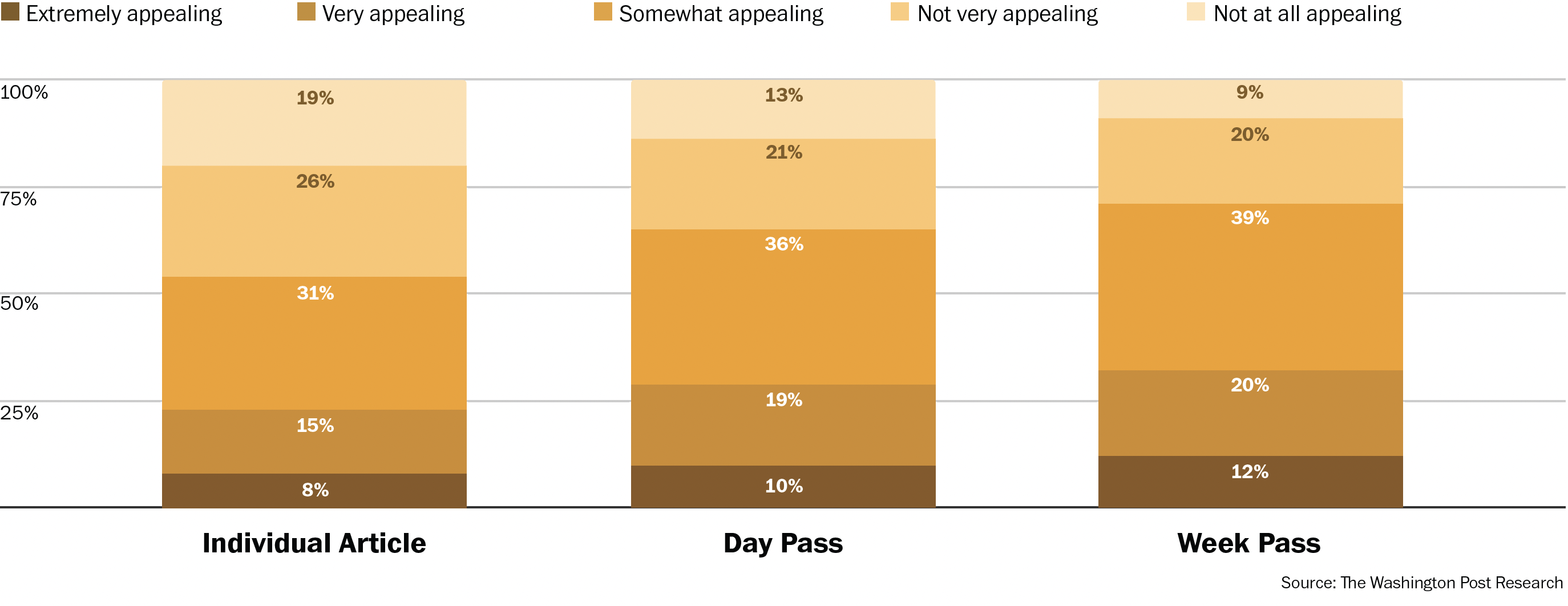
Even more interesting was the fact that of those respondents who originally told us that they were NOT open to paying for a news subscription, 43% said a week pass was somewhat, very, or extremely appealing. Forty-two percent said the same for day pass and 29% for pay-per-article.
Results from respondents who previously said they were not interested in a news subscription.

This level of demand is hard to ignore, and creating products for this segment of the market could be a key driver of paying user growth. The Post had been focused on converting those already open to subscribing but overlooked a larger opportunity: customers willing to pay yet hesitant to commit. In a world where paying for news is less common, publishers cannot afford to leave this audience behind.
It’s like owning a bakery and making only one flavor of cake. If you only sell vanilla, you are ignoring the population who loves chocolate. Selling a variety of flavors increases the chance that everyone finds something they like.
The same thinking applies to flexible access models. Instead of offering one fixed subscription, let customers choose what suits them best. Some may want a single story, others a day or a week pass, each providing a flexible way to read and engage. By giving people options, publishers can reach customers who value journalism but do not read often enough to justify a full subscription.
A common industry fear when it comes to one-time payments or access options beyond subscriptions is cannibalization, especially because very cheap one-time payment options – for example, under $10 – can’t make up for the hundreds of dollars a subscription brings in over a customer’s lifetime11. The scariest scenario for a publisher is that every paywall customer chooses a one-time payment option over a subscription.
The vast majority of prospects want a subscription, so it’s important to ensure the subscription product remains front and center. The Post’s research discovered that offering flexible access alongside a subscription not only boosts a customer’s willingness to pay, but encourages even more subscription purchases if priced right.
The Post asked U.S. adults aged 18+ in a separate survey* the following question: If you clicked on an article that you wanted to read from The Washington Post and were presented with these two options to access the article, which would you be most likely to purchase?
Flexible access options like pay-per-article, day pass, and week pass at various price points were included in the potential combinations, along with The Post’s standard introductory rate subscription prices.
The results showed that between 14% and 30% would go on to purchase, depending on the price and positioning of a flexible access option and subscription. For example, the choice between a $10 week pass or a $2 monthly subscription had the highest rate of purchase (30%), but only 1% of those customers chose the $10 week pass. The week pass price anchored and strengthened the appeal of a subscription.
Options were a $10 Week Pass or an All-Access Subscription for $2 every four weeks.
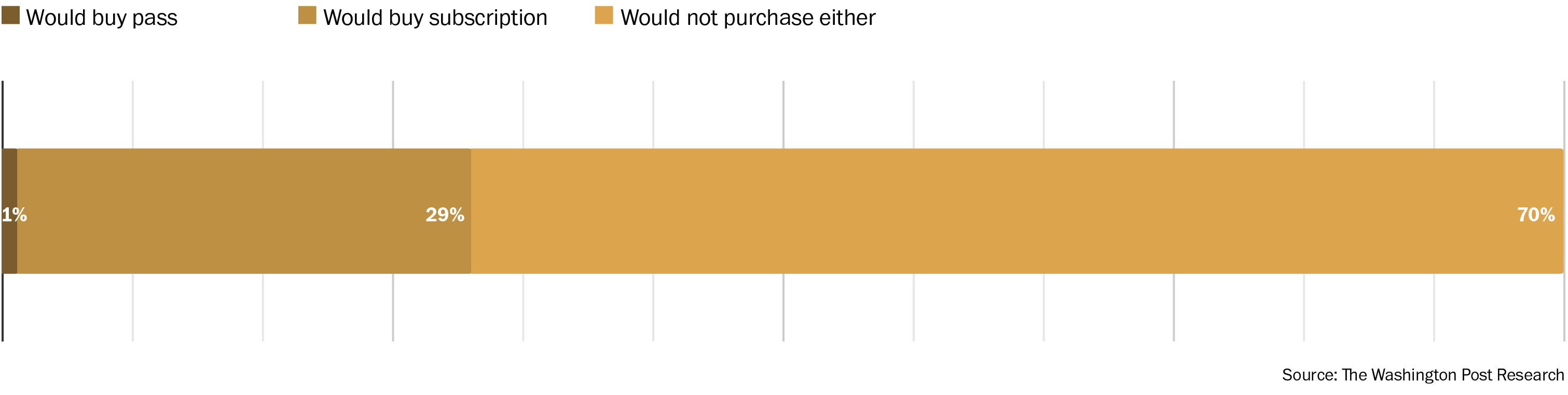
Notably, the flexible access option wasn’t the most popular pick among respondents in any of the scenarios. This has a lot to do with the fact that a flexible access option is not the most cost-effective option if a customer is planning to read over a longer time period. The flexible access product reminds customers of the value of a subscription and makes the price commitment seem more reasonable.
At the end of the day, if a customer is willing to pay and is open to a subscription, they will subscribe if it’s the best economic choice. So while the cannibalization risk is present, it might not be as extreme as immediately perceived by the industry.
A flexible access model also unlocks more opportunities for casual customers to sample a publisher’s content and get a feel for what is offered. Usually a customer has to commit to a subscription before they are able to read multiple articles at once. A day pass or week pass makes sampling easier for a customer and might lead to more downstream subscription conversions in the future. The industry has already adopted registration models for sampling. Flexible access could strengthen this model.
In addition to reducing friction and expanding reach, flexible access introduces a few revenue drivers that indicate long-term growth. Early results point to four areas of impact:
Taken together, these patterns show how flexible access can reshape customer behavior and overall economics. As this model evolves, the next step is to match choices more precisely to each customer. A smart customer paywall strengthens these outcomes by presenting options that reflect individual reading patterns and signals of intent. As personalization improves, customers are guided toward the access path that offers the right balance of value and commitment. This approach supports customer choice while improving the yield of each interaction, creating a model that becomes more efficient and more predictive over time.
The customer research The Post conducted showed a clear opportunity to better align customer preferences while preserving financial viability. The Post started testing flexible access models in 2024.
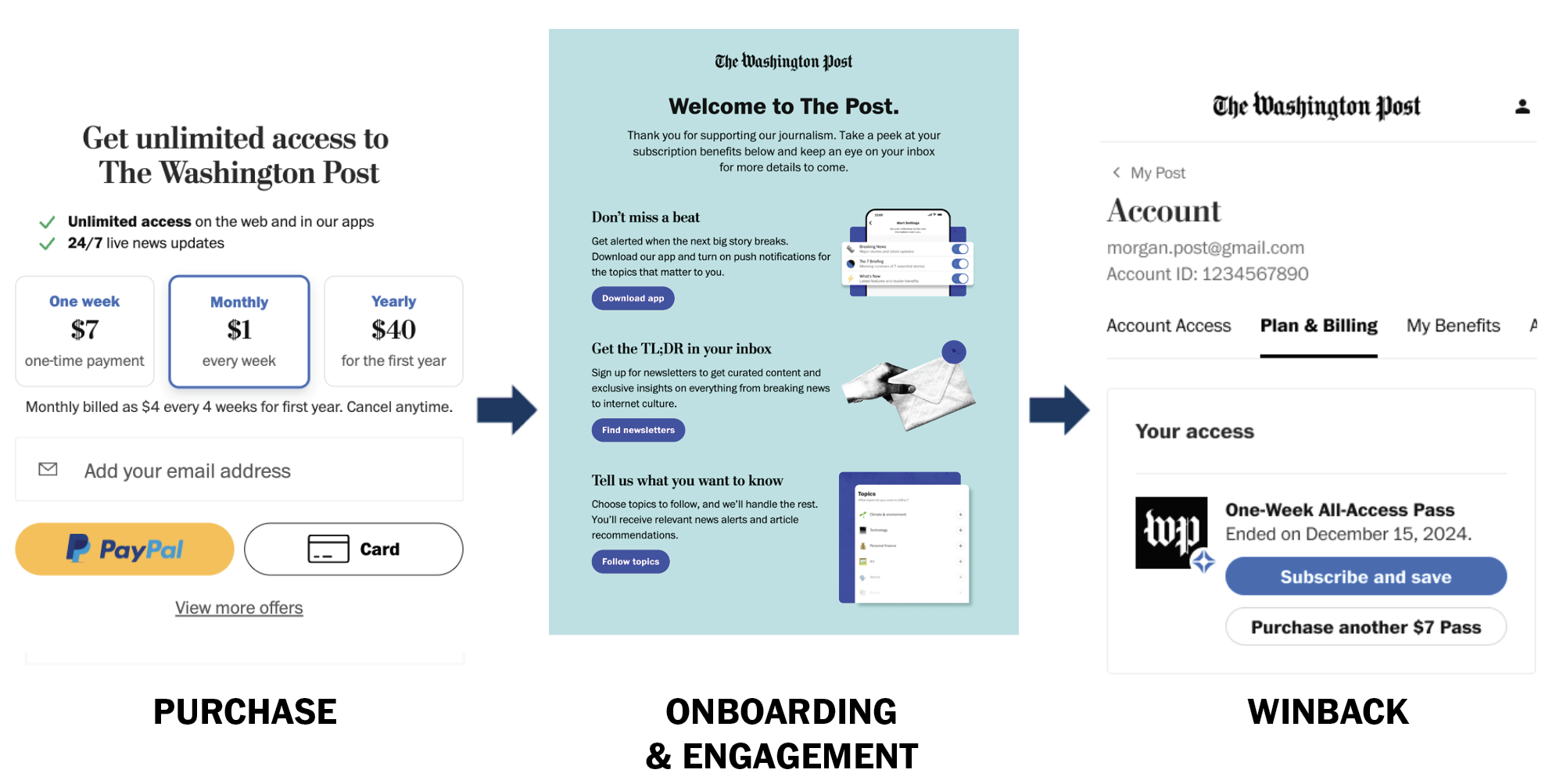
The week pass test launched on the paywall in September 2024 at three price points: $4, $7, and $10. Pass purchasers unlocked full access to The Post’s site and app for seven days, including subscriber-only features like commenting and article gifting.

Every purchaser was auto-enrolled in The 7 newsletter to deepen engagement during and after access. When passes expired, customers were treated as warm leads and targeted with winback messaging promoting both repeat pass purchases and full subscriptions.
Customer response was immediate and strong, especially from customers who had never subscribed to The Post before. Paywall bounce rates fell and conversion rates rose.
Overall, results showed The Post effectively balancing accessibility pricing and product value. The $7 pass ultimately won the pricing test, and its success has unlocked further flexible access innovation at the company.
The week pass learnings led The Post to test a day pass at three different price points in spring 2025, then a $2 pay-per-article option in fall 2025.
Those two flexible access options drove a higher rise in conversion rates than the week pass did when shown alongside subscription options, leading to a higher lift in overall paying users.
This model benefits both parties: Customers pay only for the content they want, and The Post builds long-term loyalty while monetizing previously untapped audiences. The scale of these early results positions The Post to lead industry conversations about how flexible access can advance growth, trust, and sustainability across the industry.

In early 2026, The Post settled on a flexible access strategy showing $2 pay-per-article options during non-sale periods and $4 day pass options during sale periods to balance price positioning in relation to a subscription.
These flexible access options continue to see high conversion rates, strong repurchase and upsell rates, and better retention for subscribers who see those options alongside a subscription offer and choose to subscribe.


In addition to The Post launching flexible access options on its paywall in the last year, other publishers have been experimenting.
For example, The Toronto Star has adopted a casual payments system for customers who do not want to commit to a news subscription. The Star is partnering with the casual payments company Axate to offer customers one article for $0.75 or full access to the site for a day for $1.5012. Gannett, now known as USA Today Co., announced in July 2025 that it would soon begin offering a pay-per-article option to casual customers13. The Post launched its first pay-per-article test in September 2025.
Third-party partners, like Axate, Fewcents and Content Credits, have been building functionality for publisher-focused flexible payment models.
In June 2025, Google announced Offerwall to give publishers more options to monetize14. Powered by a company called Supertab, this Google Ad Manager add-on lets publishers give their customers a variety of ways to access content, including non-subscription options like one-time payments, taking surveys, and watching ads. This product has been reportedly tested by 1,000 publishers so far, and Google reported an average revenue uplift of 9%15. A unique feature of its one-time payment option is that customers don’t pay until they reach a $5 tab – one way that publishers might be able to combat the burden of transactional fees associated with micropayments.
The pioneering Dutch micropayment service Blendle shut down in 2019 after failing to turn a profit. It acted as a third-party partner for German and U.S. publishers to support the pay-per-article model16. It launched in 2013 as the “iTunes for news17.”
Another company called Post News that offered news customers the ability to pay by article with their partner outlets also shuttered in 202518.
These examples highlight the need to learn from past attempts. Our challenge has never been customer interest in flexible models, but rather fragmented execution, weak product integration, and reliance on third-party intermediaries.
While flexible payments are not yet common among major publishers in the U.S., this may change with Offerwall, as Google Ad Manager is used by 73% to 81% of publishers worldwide19. With more flexible access adoption, we could see openness to paying for news increase over time.
It’s also worth examining how other industries, outside of publishing, approach flexible payment models. Many take the form of the “subscribe and save” model where the price per item is higher on a one-time-payment basis. This model relies heavily on price anchoring and value proposition.
For example:

One-time access is often dismissed within the industry. Critics argue these products don’t boost conversion, fail to grow revenue, and are costly to implement11. However, there are insights from The Post’s and others’ experimentation that prove otherwise.
We’ve already touched on the fear of cannibalization and how a smart pricing strategy can mitigate this significantly. For example, The Post’s $4 day pass offer paired with a subscription offer increased total paywall conversion rates, leading to incremental paying users who would otherwise bounce without a flexible access offer.
We observed a 35% lift in conversion with the $4 day pass, while pay-per-article delivered an 83% conversion rate lift.

Publishers need to also consider the value of bringing in more loyal, higher-retaining subscribers. For example, a paywall with one-time payments and subscription options helps filter out customers who would otherwise subscribe, read, and then immediately cancel.
If your subscriber retention rate goes up, the subscriber customer lifetime value also increases. Offering more choices to customers can boost a publisher’s subscription value. The products truly complement one another and should not be viewed as direct competitors. Instead of looking at success on a per-product basis, the industry should look more holistically at the overall product mix and what brings in the most valuable customers overall. It all works together: Subscribers become more engaged and publishers grow their customer base.
There’s also the repurchase rate to consider in the equation. For example, The Post has benchmarked that 1 in 10 of $4 day pass customers will go on to repurchase or subscribe in 180 days organically, without any pass-specific customer journeys or promotional efforts.

These organic results are partially driven by the price anchoring and positioning. Four dollars for one day of access is the same price as The Post’s monthly subscription intro rate of $4 every four weeks. If a customer has bought a day pass for $4 and is looking to read more after their pass expires, it becomes a no-brainer to start saving money with a subscription.
The Post found that a flexible access customer is also more likely to gravitate to content outside of The Post’s core politics and opinions sections – which creates a meaningful audience growth opportunity. The content that draws these customers complements the content that drives subscription conversion. While subscribers typically convert on investigations, policy coverage, politics, and opinions, flexible access customers often begin with a wider range of content beyond core news. These customers engage with lifestyle, food, service journalism, culture, and evergreen topics that sit outside the areas where The Post is traditionally known to excel. These new customers may not engage with core coverage until later in their journeys. This broadened visibility into more of the newsroom’s work expands the brand’s appeal.

Last but not least, The Post was able to build its flexible access model entirely in house, which meant it continued to own the customer, had 100% control of messaging, and didn’t have the added challenge of revenue shares from third-party partners.
The Post plans to continue testing its flexible access model in 2026 to unlock customer growth. If you’re a publisher intrigued by the flexible access model, keep in mind the following points:
Define clear objectives and metrics: Identify the problem you aim to solve, whether it is reducing access barriers, unlocking new revenue streams, or reaching audiences underserved by the current model.
Partner across your organization: Successfully launching and promoting a flexible access model requires thoughtful planning, testing, and alignment across departments like product, engineering, marketing, and finance.
Determine the right access model for your customer: A range of low-friction, reader-friendly formats can align with different needs and behaviors. For example, a weekly or topic-specific pass could appeal to customers who follow key events (e.g., elections, investigations), thus reaching new audiences and increased revenue during peak interest.
Develop a strategic pricing framework: Conduct customer research before you start implementation to understand optimal pricing and ensure you solve for your customers’ needs. Ensure you aren’t devaluing your subscription product.
Create a smart test plan: Limit your testing variables. It’s important to understand how the product alone is driving the results, rather than new copy, buttons, or check-out flows.
Prepare for the results before you launch: Conduct a financial and sensitivity analysis to model various scenarios to understand revenue impact and scalability. This includes assessing breakeven points, customer acquisition costs, and long-term contribution margins.
Offering customers greater choice in accessing and paying for journalism would be a step forward for our industry, and we welcome further dialogue. A customer-centric publishing industry could help grow the paying user base within the U.S. and beyond. Pay-per-article, day passes, and week passes are not replacements for subscriptions. Rather, they are valuable complements that expand the funnel, reduce friction, and strengthen long-term loyalty.
Based on observed performance and customer behavior, the most effective product offering mix today is the $4 day pass and $2 per article option. These options reflect different customer needs and moments, from broader time-bound access to more specific article level use cases. Together, they reduce friction at the point of conversion, expand the pool of paying users, and create a scalable pathway toward increased engagement and future subscription growth.
This paper is a cross-departmental effort. We extend our sincere gratitude to the following Washington Post teams for their invaluable contributions: Subscriptions Marketing, Product, Product Design, Engineering, Insights & Analytics, Finance, Revenue Science, Research, Legal, News & Opinions, Communications, Brand, Partnerships, and Client Solutions.
1 Tomasik, Lipka, and Pew Research, “Few Americans Pay for News When They Encounter Paywalls.”
2 Piano, “Subscription Performance Benchmarks 2024 Report.”
3 “Key Events in the Corporate History of the Associated Press News Service | Articles and Essays | Associated Press News Dispatches, 1915-1930 | Digital Collections | Library of Congress.”
4 “CNN | History, Programs, & Facts | Britannica Money.”
5 Lambertini and Montagu, “The Evolution of Paywalls, Pricing, and Trials in the News Industry.”
6 Newman et al., “Reuters Institute Digital News Report 2025.”
7 Felps, “As Search Ends for News, Here Is What’s Next.”
8 International News Media Association (INMA), What’s really behind the drop in search traffic to news sites?
9 International News Media Association (INMA) 2025 Benchmark Study
10 Caporal, “Survey: Most Believe They’re Overpaying for Their Subscriptions.”
11 Ball, “Why Micropayments Will Never Be a Thing in Journalism.”
12 Hernandez, “Torstar Introduces ‘Pay as You Go’ Option for Casual News Readers.”
13 Fu, “Gannett Is Cutting $100 Million and Rethinking Subscriptions to Curb Falling Revenue.”
14 Patel, “Offerwall Gives Publishers More Options to Monetize and Audiences More Control Over How They Access Content.”
15 Perez, “As AI Kills Search Traffic, Google Launches Offerwall to Boost Publisher Revenue.”
16 Granger, “Blendle Shuts Down Micropayment Model Due to ‘Very Limited User Base.’”
17 Edmonds, “Blendle, the Dutch ‘iTunes for News,’ Arrives in the U.S. With Major Partners.”
18 Silberling, “Post News, the A16z-Funded Twitter Alternative, Is Shutting Down.”
19 Piechota, “Google Brings News Content Micropayments to Their Moment of Truth.”
*Those surveyed read news online at least once a week, read Washington Post content in the past 3 months, and did not currently pay for a Washington Post subscription.